What is a Cataract
Cataracts occur when the lens in your eye become cloudy from natural proteins that build up with age, and sometimes due to eye disease, injury or side effects of some medications. Patients with cataracts can experience blurred vision, changes in their glasses’ prescription, ghosting or double images, and glare.
How Are Cataracts Treated
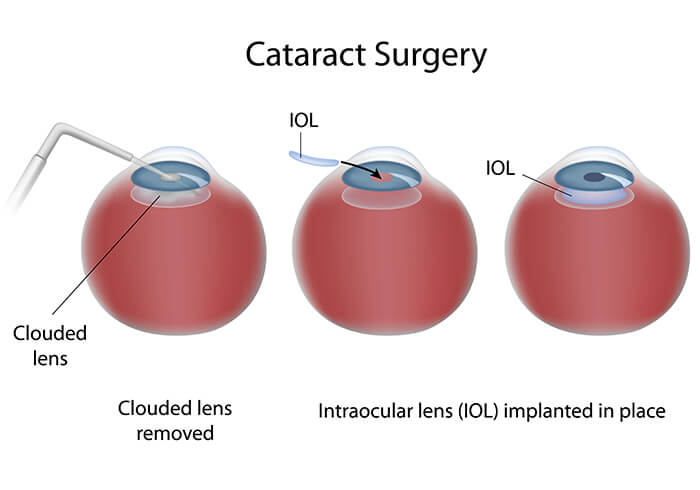
Cataracts are treated with surgery. Patients receive drops to freeze the eye and a mild sedative so they are relaxed but awake. The clouded lens is broken down into pieces and removed through small incisions leaving its natural housing (capsule) intact. An artificial lens implant is then placed in the capsule where the original cataract lens used to be.
The new lens implant creates a new prescription for glasses, and it is common to require them for distance (driving, watching television), middle (computer, tablet, car dashboard) and near (reading books, labels) after surgery. There are optional advanced tests and lens implants that can improve the quality of vision and reduce or even eliminate (for most tasks) the need for glasses after surgery.
What Can I Expect After Surgery
After surgery, you will need to purchase and take drops for 1 month starting a few days before surgery. After surgery, the eye may feel scratchy, light sensitive and vision will be blurred for a few days. Lubricating drops and sunglasses can be helpful. You can do most activities including walking, cooking and bathing. You should avoid rubbing the eye and submerging it underwater for 1 week after surgery, though you can shower and wash as usual. Most patients return to normal activities including work after 1 week.
Unless you choose an advanced testing and lens option designed to allow vision without glasses after surgery, you will not see your best until you update your glasses. You should see your optometrist for this a month after surgery once the prescription is stable. Dry eyes (discomfort, redness and reflex tearing) are common in general and can be worse for a few months after surgery – lubricating drops can be helpful.
It’s important to remember that cataract surgery can only correct vision loss caused by cataracts. If you already have vision loss from other eye diseases including corneal scarring, macular degeneration, diabetes, retina membranes or glaucoma, that limitation will still be there after your cataract surgery. Months or years later, the capsule housing the lens implant can become cloudy. This can be resolved with a minor laser treatment that is done in the office and covered by OHIP.
Video: Non-OHIP options
What is Covered By OHIP and What is Not?
OHIP pays for the medically necessary parts of cataract surgery which include a basic measurement of the eye, removal of the cloudy cataract and the cost of a basic lens implant.
OHIP does not pay for the eye drops you will need before and after cataract surgery, or the updated glasses you may need to see well after the surgery.
There are advanced testing and advanced lens options that can improve the quality of vision and reduce your need for glasses after surgery. These are not covered by OHIP and those patients who want them pay for them through insurance or personally.
Advanced Testing
To select the right power (“size”) lens implant, the eye must be measured before surgery. Advanced measurements are more precise and measure the eye shape in different ways. These tests help to reduce the distance prescription and to properly fit the advanced lens so it provides the right result.
Advanced Lenses
Femtosecond Laser Assisted Surgery
A computer guided laser can be used to create cataract incisions and break up the cataract instead of the traditional manual technique. The laser provides accuracy, fine tuning and helps to soften the cataract so that it can be broken down and removed using less energy inside the eye.
What are the Risks of Surgery
Cataract surgery is the most commonly performed surgery in the world and is safe. Like all surgeries, it does carry some risk. Most complications can be treated and some may require additional procedures.
Severe complications are rare and include infection, inflammation, bleeding, loss of corneal clarity, retinal detachment, glaucoma (high eye pressure with damage to the optic nerve and peripheral vision loss). Loss of vision, loss of the eye or serious medical complications caused by a reaction to the sedative or anesthesia are very rare.
Less severe complications include retained pieces of cataract in the eye, retinal swelling, dry eyes, chronic eye pain, droopy eyelid, double vision, irregular pupil, iris thinning, wound leak, an increase in the shape, size or number of floaters.
During surgery, complications can occur requiring a change in the planned lens or in some cases a lens cannot be implanted until later on. After surgery, lens implant related complications can include halo, glare, shadows, double or ghost images. Although uncommon, lens implants are sometimes repositioned or replaced if they move, opacify or are not tolerated by the eye.
How Do I Get Started









Our Locations
Brampton
- 7700 Hurontario Street, Unit 605
- Brampton, Ontario L6Y 4M3
Monday to Saturday: by appointment only
OUR HOURS
- Monday: 7:30 AM – 6:00 PM
- Tuesday: 7:30 AM – 6:00 PM
- Wednesday: 7:30 AM – 6:00 PM
- Thursday: 7:30 AM – 6:00 PM
- Friday: 7:30 AM – 6:00 PM
- Saturday: 8:00 AM – 2:00 PM
- Sunday: Closed
Mississauga-Oakville
- 2201 Bristol Circle, Suite 100
- Oakville, Ontario L6H 0J8
Monday to Saturday: by appointment only
OUR HOURS
- Monday: 7:30 AM – 6:00 PM
- Tuesday: 7:30 AM – 6:00 PM
- Wednesday: 7:30 AM – 6:00 PM
- Thursday: 7:30 AM – 6:00 PM
- Friday: 7:30 AM – 6:00 PM
- Saturday: 8:00 AM – 2:00 PM
- Sunday: Closed
Our Brampton Reviews
Our Mississauga-Oakville Location
Gallery